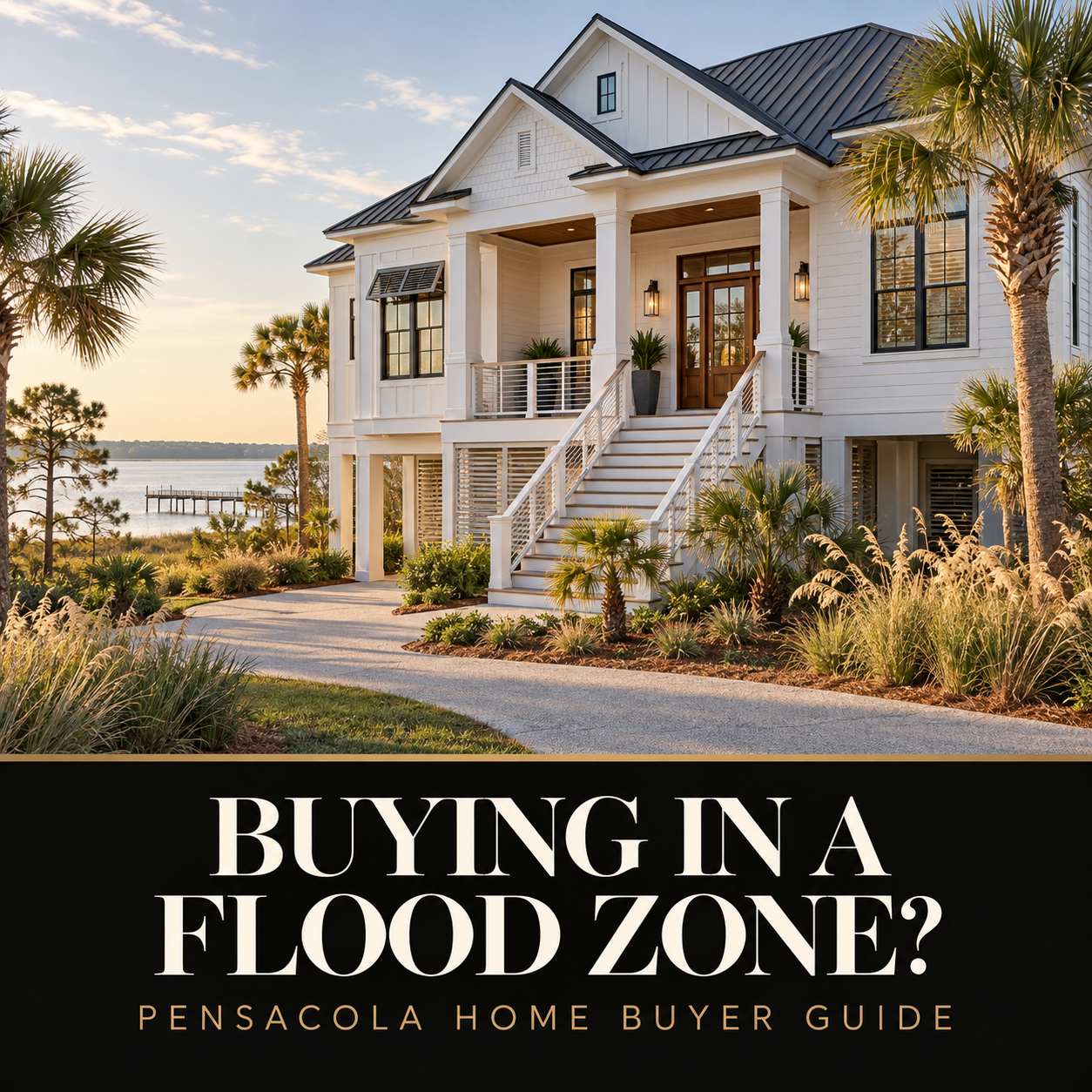
Living near the water is one of the things many people love about the Pensacola area. However, when buyers begin looking around Pensacola Beach, Perdido Key, Gulf Breeze, Milton, Pace, Beulah, or other parts of Escambia and Santa Rosa counties, flood zones can quickly become part of the conversation.
The short answer is yes, you can buy a house in a flood zone. The important question is whether you understand the property's specific flood risk, insurance cost, elevation, history, and lender requirements before making an offer.
A flood-zone designation does not automatically mean you should avoid a home. It does mean you should complete additional research so you can make a confident and financially comfortable decision.
What Does a Flood Zone Mean?
FEMA flood maps divide properties into areas with different levels of mapped flood risk. Areas beginning with A or V are generally considered Special Flood Hazard Areas.
If a property is located in a Special Flood Hazard Area and the buyer uses a government-backed mortgage, flood insurance is generally required. The requirement is connected to the property and loan, not simply the buyer.
Properties in Zone X are generally outside the highest-risk areas shown on FEMA's maps. However, Zone X does not mean there is no possibility of flooding. Heavy rainfall, drainage problems, nearby waterways, storm surge, and changing conditions can affect properties outside a designated high-risk zone.
Check the Current Map for the Exact Address
Never determine a home's flood zone based only on the neighborhood, ZIP code, or distance from the water. Flood-zone boundaries can cross individual streets and properties.
Escambia County provides an address-based property lookup for its current flood-zone information. The county states that its current maps became effective on August 19, 2025.
Santa Rosa County's Floodplain Management office maintains flood maps, elevation certificates, flood studies, map amendment records, and property-level flood-risk information.
FEMA's Flood Map Service Center is the official federal source for National Flood Insurance Program mapping products.
Because maps can change, verify the address using current official resources rather than relying on an older listing, previous survey, or informal online map.
Request an Insurance Quote Before Your Deadline
One of the most important steps is obtaining an insurance quote for the specific property as early as possible.
Standard homeowners insurance usually does not cover flooding. Flood coverage is generally purchased separately through the National Flood Insurance Program or an eligible private insurance company.
Do not assume the cost based on another home nearby. Flood insurance pricing may be influenced by the property's location, elevation, foundation type, replacement cost, coverage choices, and other risk information.
Ask the insurance agent to explain:
1. Whether flood insurance will be required by the lender
2. The estimated annual premium
3. The building and contents coverage being quoted
4. The deductibles
5. Whether the quote is through the NFIP or a private carrier
6. Which losses or property are excluded
7. Whether an existing flood policy may be transferred or assumed
FloodSmart notes that buyers moving into a higher-risk zone may be able to assume the previous owner's current NFIP policy in some circumstances. This should be confirmed directly with the insurer.
Ask for the Elevation Certificate
An elevation certificate contains information about a building's elevation compared with the mapped flood elevation. If one is available, it can help an insurance professional, surveyor, lender, or floodplain official evaluate the property.
Santa Rosa County maintains elevation certificates and provides flood-map determinations through its Floodplain Management office.
If the seller does not have an elevation certificate, ask your insurance agent and lender whether one would be helpful. A licensed surveyor can normally prepare one when needed.
Remember that two houses in the same mapped flood zone may have very different elevations and construction features. A home elevated above the surrounding grade may present a different situation from a home with living space closer to ground level.
Investigate the Property's Flood History
A map shows modeled risk, but it does not tell you everything that has happened at a particular property.
Ask whether the home or surrounding property has experienced:
1. Water entering the structure
2. Storm-surge flooding
3. Standing water after heavy rain
4. Drainage or sewer-backup problems
5. Previous flood-insurance claims
6. Repairs related to water intrusion
7. Federal disaster assistance
The Consumer Financial Protection Bureau recommends asking about previous flooding, insurance claims, disaster assistance, current insurance costs, and steps taken to reduce future risk.
A home inspection may also reveal visible moisture damage or drainage concerns, but a general home inspection is not a guarantee that every past or future flooding issue will be identified.
Look Beyond the House Itself
The structure is only part of the decision. Consider how water could affect the entire property and your ability to use it.
Look at the driveway, garage, yard, drainage areas, nearby ditches, road elevation, and access routes. Ask whether the road leading to the home has experienced flooding, even if the house remained dry.
For waterfront, coastal, or low-lying properties, you may also want advice from a floodplain professional, engineer, surveyor, insurance agent, or other qualified specialist.
Should You Buy the Home?
Buying in a flood zone is a personal financial decision, not an automatic yes or no.
Before moving forward, make sure you are comfortable with the insurance premium, deductibles, potential maintenance, evacuation planning, and possible future changes to maps or insurance costs. Your lender, insurer, and appropriate property professionals should answer questions within their areas of expertise.
My role is to help you gather the property information, coordinate the right questions, and compare your options without pressure.
If you are considering a home in Pensacola, Perdido Key, Pensacola Beach, Gulf Breeze, Beulah, Cantonment, Pace, Milton, Escambia County, or Santa Rosa County, contact me before making an offer. I would be honored to help you approach the purchase with clarity and confidence.